
Menopause night sweats remedies: what works, what doesn't (2026)
Menopause night sweats remedies that help: a cool bedroom, layered bedding, fewer triggers and treatments to ask your doctor about, plus supplements to skip.
The most helpful menopause night sweats remedies start in the bedroom: keep it cool (around 65°F), use light, layered bedding and breathable pajamas, keep cold water and a fan within reach, and cut back on evening triggers like alcohol, spicy food and hot drinks. If night sweats still wake you regularly, the treatments with the strongest evidence are prescription ones, including hormone therapy and newer nonhormonal medicines, which are worth discussing with your doctor. Most herbal supplements have weak or no evidence behind them.
Night sweats are hot flashes that happen while you sleep. They can soak your pajamas and sheets, wake you with your heart pounding, and leave you lying awake long after you've cooled down. Here's what you can do tonight, and what to ask for if it isn't enough.
Why menopause causes night sweats
Estrogen and progesterone help your body control its temperature. As these hormones rise and fall unpredictably in perimenopause and then decline, your internal thermostat can misfire: your body suddenly reacts as if it were overheating and sweats to cool down. Cleveland Clinic notes that up to 3 in 4 people have hot flashes in perimenopause, typically starting in the late 40s and lasting months to years.
At night, this collides with sleep. A hot flash can wake you directly, and the sweat, the damp sheets and the chill afterward can keep you awake, often in the lighter sleep of the early morning (see why you wake up at 3 AM). Our guide to perimenopause sleep problems explains the bigger picture.
Set up your bedroom for night sweats
This is where you have the most control, starting tonight.
- Lower the thermostat. The Sleep Foundation suggests about 65°F (18°C) as a good target for most people, with a comfortable range of roughly 65 to 68°F. If night sweats wake you, start at the cooler end.
- Layer your bedding. Several light layers (a sheet plus a light blanket) instead of one heavy duvet let you take one off during the night without fully redoing the bed.
- Choose breathable fabrics. Cleveland Clinic suggests loose, lightweight cotton or linen pajamas.
- Add airflow. A fan by the bed, an open window or air conditioning helps your skin shed heat.
- Try cooling products. Cooling gel pillows or mattress covers can help some people.
- Keep a kit by the bed. Cold water to sip, a spare T-shirt and a small towel mean you can reset in a minute and go back to sleep.
An honest note: when The Menopause Society reviewed the evidence in 2023, it did not recommend cooling techniques or trigger avoidance as treatments, because studies haven't shown they reduce how many hot flashes you have. That doesn't make them useless. A cool, well-set-up bedroom makes each night sweat easier to sleep through, which is what matters at 3 AM.
Night sweat triggers to watch
According to Cleveland Clinic, common hot flash triggers include:
| Trigger | What to try instead |
|---|---|
| Alcohol | Skip it in the evening, or stop well before bed |
| Spicy foods | Keep spicy meals to lunchtime |
| Caffeine | Coffee and tea in the morning only |
| Hot drinks | Switch to cool or room-temperature drinks at night |
| Hot showers or baths | Lukewarm water in the evening |
| Warm rooms and heavy clothing | Cool bedroom, light layers |
| Stress | A wind-down routine, slow breathing |
| Smoking | Quitting helps hot flashes and your overall health |
Triggers vary from person to person. The best approach is to notice your own: keep a short note of what you ate, drank and did on the evenings before your worst nights.
Natural remedies for night sweats: what the evidence says
Many supplements are marketed for menopause, and it's understandable to want something "natural." Here is where the evidence stands:
- Black cohosh, evening primrose oil and vitamin E: Cleveland Clinic says most experts don't recommend them, because studies were small, had major limitations, or showed no real benefit for hot flashes.
- Soy and other phytoestrogens: generally safe to eat as food, but the evidence for relief is not strong. The Menopause Society's 2023 statement did not recommend soy foods, soy extracts or equol for hot flashes. If you have a history of breast cancer, talk to your doctor first.
- Supplements and herbal remedies in general: The Menopause Society did not recommend them, after reviewing the research.
- Mind-body approaches: cognitive behavioral therapy (CBT) and clinical hypnosis were both on The Menopause Society's list of recommended nonhormone options. Weight loss was also recommended for women who carry extra weight.
Supplements can interact with medicines and health conditions, so always check with your doctor or pharmacist before starting one.
Medical treatments to discuss with your doctor
If night sweats are wrecking your sleep, there are treatments with real evidence behind them. They each have pros, cons and risks, so this is a conversation for your doctor, not a menu.
- Hormone therapy (estrogen, combined with a progestin if you still have your uterus) is one of the main treatments for hot flashes and night sweats. All hormone therapies carry some risks, so whether it's right for you depends on your age, health and family history.
- Fezolinetant (Veozah): approved by the FDA in 2023 as the first medicine of its kind, it blocks a brain receptor (NK3) involved in temperature control. The FDA's announcement includes a warning about liver injury and calls for blood tests before starting and regularly during the first months of treatment.
- Elinzanetant (Lynkuet): a newer nonhormonal option that also targets the brain's temperature-control pathways, listed by Cleveland Clinic among FDA-approved treatments for moderate to severe hot flashes.
- Low-dose paroxetine: an antidepressant at a low dose, FDA-approved for hot flashes.
- Other medicines used off-label, such as certain antidepressants, gabapentin and oxybutynin, which The Menopause Society also lists among recommended nonhormone options.
When night sweats need a check-up (it's not always menopause)
Night sweats around 50 are very often menopause, but they have many other possible causes. Cleveland Clinic lists infections (including flu and COVID-19), medicines (some antidepressants, blood pressure drugs, pain relievers, steroids and others), an overactive thyroid, diabetes, sleep apnea, anxiety, alcohol, and, more rarely, cancers such as lymphoma.
Call your doctor if:
- night sweats come with fever, unexplained weight loss, chest pain, a racing heartbeat or shortness of breath (MedlinePlus lists these as reasons to get checked);
- you sweat heavily during sleep often, or the sweating can't be explained;
- they started with a new medicine;
- you are not in the age range for perimenopause or menopause;
- they disrupt your sleep, whatever the cause.
Use your Apple Watch's wrist temperature to spot warm nights
If you wear an Apple Watch to bed, it may already be measuring something useful. Apple Watch Series 8 or later, every Apple Watch Ultra and Apple Watch SE 3 record your wrist temperature while you sleep, sampling it every five seconds. After about 5 nights, the watch sets your personal baseline and then shows each night as a change from it in the Health app (Browse, then Body Measurements, then Wrist Temperature). It isn't a thermometer and it can't diagnose anything, but it can show which nights ran warmer than your usual. See how to track sleep on Apple Watch to set it up.
The Health app shows the temperature and your sleep separately, though. Sleepwrist puts them together: on watches that record wrist temperature, it lines up your wake-ups with your warmer nights and tells you in plain words what it finds, for example that you wake up about twice as often on your warmer nights. Its "Your body" view compares each night's wrist temperature with your own 30-night baseline, in words (Just right, A bit warm, Warm), and evening tags let you see whether alcohol or a late coffee shows up in your nights.
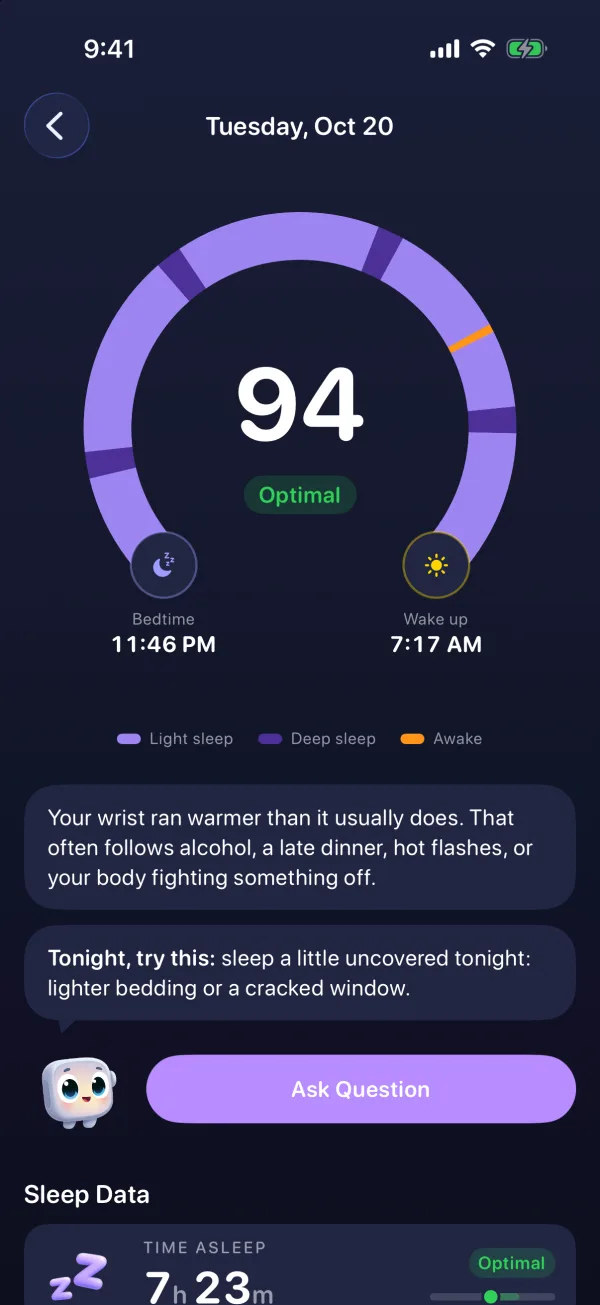
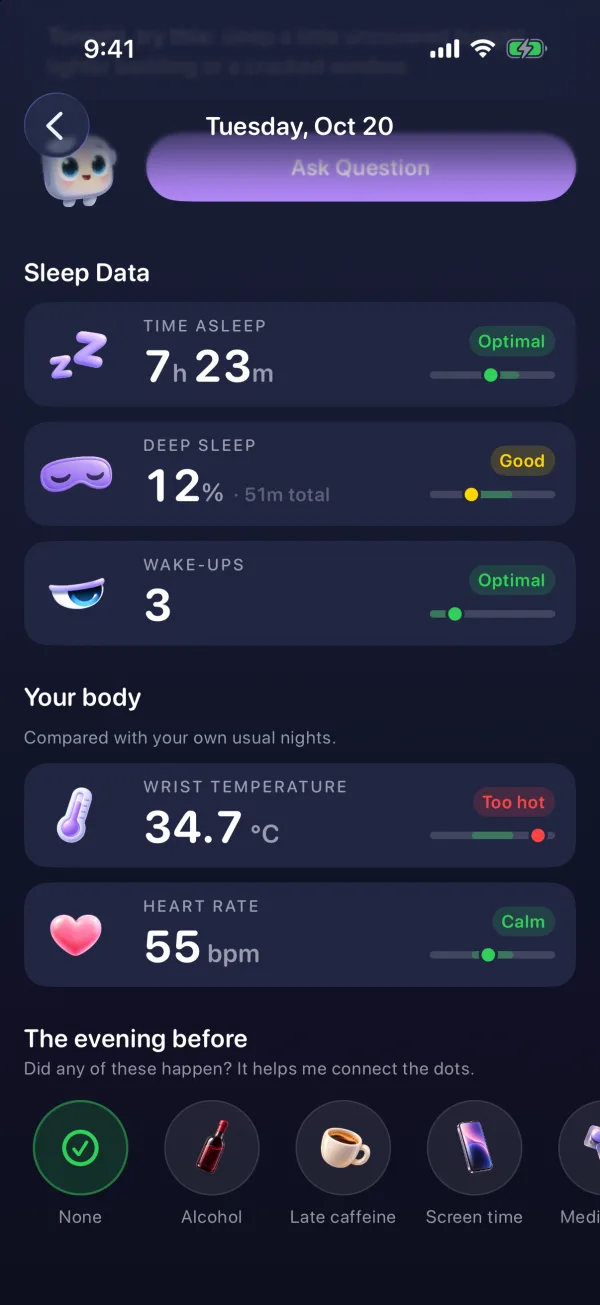
Sleepwrist also gives each night a sleep score in words (Optimal, Good, Fair, Poor), which you can compare with Apple's own sleep score. That kind of pattern is useful at home (a cooler room, an earlier last drink) and at the doctor's office, where a few weeks of warm nights and wake-ups say more than "I sweat a lot." Sleepwrist is a wellness app, not a medical device, and it doesn't diagnose anything.
Frequently asked questions
How do I stop menopause night sweats fast?
In the moment, cool down quickly: throw off a layer, turn on a fan, sip cold water and change into a dry shirt if needed. Over time, a cooler bedroom and fewer evening triggers help you sleep through them, and if they keep waking you, ask your doctor about treatment.
What is the best natural remedy for menopause night sweats?
The most reliable "natural" steps are practical ones: a cool bedroom, light layers, breathable fabrics and avoiding your own triggers. Supplements such as black cohosh and soy have weak or mixed evidence and aren't recommended by The Menopause Society. CBT and clinical hypnosis are drug-free approaches that are recommended.
What temperature should my bedroom be for night sweats?
The Sleep Foundation suggests about 65°F (18°C) for most people, within a range of roughly 65 to 68°F. If night sweats wake you, start at the cooler end and add a fan and light, layered bedding.
How long do menopause night sweats last?
They vary widely. Cleveland Clinic notes that hot flashes can go on for several months or several years. Treatment can help at any point.
Are night sweats always caused by menopause?
No. Infections, medicines, an overactive thyroid, diabetes, sleep apnea, anxiety and, rarely, some cancers can cause them. Night sweats with fever or unexplained weight loss should be checked by a doctor.
Can an Apple Watch detect night sweats?
Not directly. Apple Watch models that measure wrist temperature (Series 8 or later, Ultra, SE 3) can show nights that ran warmer than your baseline. An app like Sleepwrist can line those warm nights up with your wake-ups to show a pattern.
Sources
- Cleveland Clinic, Night Sweats: Menopause, Other Causes and Treatment
- Cleveland Clinic, Hot Flashes: Triggers, How Long They Last and Treatments
- The Menopause Society, 2023 Nonhormone Therapy Position Statement (press release)
- U.S. Food and Drug Administration, FDA approves novel drug to treat moderate to severe hot flashes caused by menopause
- MedlinePlus, Sweating
- Sleep Foundation, Best Temperature for Sleep
- Apple Support, Track your nightly wrist temperature changes with Apple Watch
This article is for general information and does not replace advice from your doctor. If your sleep problems last more than a few weeks or come with other symptoms, talk to a healthcare professional.