
Why do I wake up at 3 AM every night? The real reasons (and what helps)
Why do you wake up at 3 AM? Lighter sleep, rising cortisol, hot flashes, alcohol, stress or a bathroom trip. What to do tonight and when to see a doctor.
You wake up at 3 AM because, by then, most of your deep sleep is behind you: the second half of the night is made of lighter sleep, so any nudge (a hot flash, a full bladder, the last of a glass of wine wearing off, a worry, a warm room) can tip you awake. At the same time, your body is starting to prepare for morning, with stress hormones beginning to rise. The good news: once you know which nudge is yours, it is usually fixable.
Waking up in the night is far more common than most people think. According to the Sleep Foundation, more than 35% of people wake during the night at least three times a week. A short wake-up that you fall back asleep from is a normal part of sleep. It becomes a problem when you lie there for an hour, or when it happens almost every night.
Why 3 AM? What happens in your body at that hour
Sleep comes in cycles of roughly 90 minutes, and they are not all the same. Deep sleep (the slow, restorative stage where your body does its repair work) is packed into the first half of the night. REM sleep (the dreaming stage) and light sleep take over in the second half. So by 3 AM, you are spending more time in the stages you wake from most easily. See how much deep sleep you need for the details.
Three other things line up in the early morning hours:
- Cortisol starts climbing. Cortisol is the hormone that helps you get up and going. Researchers at the Woolcock Institute describe it starting to rise between about 3 and 5 AM and building toward a peak after you wake, typically between 6 and 8 AM according to the Sleep Foundation. If you are stressed, an earlier or sharper rise can jolt you out of light sleep.
- Your body is shifting toward wakefulness. The nervous system starts moving out of "rest mode" in the small hours, which can turn tiny, normal micro-awakenings into full wake-ups when there is light, noise or worry.
- Your temperature is at its low point. Your core body temperature (the temperature deep inside you) drifts down through the night and usually reaches its lowest point about two hours before your usual wake-up time. To cool your core, your body sends heat out to your hands, feet and wrists, which is why your skin can feel warm at night even though your inner temperature is dropping. A room that is too warm, or heavy covers, makes that heat harder to shed.
None of this means something is wrong with you. It means 3 AM is a fragile hour, and the reasons below are what usually tip it over.
The most common reasons you wake up at 3 AM every night
| Reason | What it usually feels like | First thing to try |
|---|---|---|
| Hot flashes or night sweats | Waking up hot, sweaty or kicking off the covers | Cooler room, lighter layers |
| Alcohol in the evening | Sleeping fine at first, then awake and restless | Stop drinking at least 3 hours before bed |
| Stress or anxiety | Mind racing the moment your eyes open | A wind-down routine, CBT-I if it persists |
| Bathroom trips | Waking with a full bladder | Fewer drinks in the last hours of the evening |
| Room too warm | Feeling hot without a true hot flash | Bedroom around 65°F, breathable bedding |
| Going to bed too early | Wide awake, as if your night is "done" | Try a bedtime 30 to 60 minutes later |
| Possible sleep apnea | Snoring, gasping, morning headaches, daytime sleepiness | Talk to your doctor |
Hormonal changes after 40: hot flashes and night sweats
If you are in your 40s or 50s, this is often the big one. During the menopausal transition, falling estrogen and progesterone change how your body controls its temperature and how deeply you sleep. A review of the research in Sleep Medicine Clinics found that trouble staying asleep is the most common sleep complaint in this stage, and that women with moderate to severe hot flashes were almost three times as likely to report frequent night wakings.
The link can run both ways. In one study cited in that review, about 69% of hot flashes happened at the same time as an awakening, and the National Institute on Aging notes that waking up may itself trigger some hot flashes, rather than only the reverse. Either way, calming the heat usually calms the wake-ups. Our guides on perimenopause sleep problems and night sweats remedies go deeper.
Alcohol: the "nightcap" that wakes you up later
A glass of wine can make you drowsy, but the bill arrives later. The Sleep Foundation explains that alcohol tends to deepen sleep early in the night, then, as your body clears it, sleep turns lighter and more broken, with more awakenings in the second half. That is exactly the 2 to 4 AM window. Experts suggest stopping alcohol at least three hours before bed, and longer if you are sensitive to it.
Stress, worry and a "conditioned" wake-up
When life is full (work, aging parents, grown kids, your own health), your brain can grab the first quiet moment at 3 AM to start working through the list. Over time, waking at the same hour can also become a habit. Cleveland Clinic sleep psychologist Alicia Roth, PhD, describes how the brain and body can become conditioned to wake at a set time, almost "like clockwork." Going to bed too early can play a part too: if you turn in long before you are sleepy, your sleep drive may simply run out in the middle of the night.
Bathroom trips
Needing to pee at night (doctors call it nocturia) is a common cause of night waking, especially as we age. Drinking a lot in the evening and some medicines, like diuretics ("water pills"), make it more likely.
A warm bedroom
Because your body is trying to shed heat in the early morning, a room that is too warm, a heavy duvet or synthetic pajamas can wake you up even without a true hot flash. The Sleep Foundation suggests a bedroom around 65°F (about 18°C), give or take a few degrees.
Sleep apnea: when to take it seriously
Sleep apnea is a condition where breathing stops and starts during sleep, each pause briefly waking you, often without you remembering it. It is not only a "men's problem." In a large study cited by the Sleep Medicine Clinics review, women after menopause were 2.6 times as likely as women before menopause to have at least mild sleep apnea, and 3.5 times as likely to have the moderate or worse kind. Women are also more likely to have insomnia-like symptoms and to go undiagnosed. Loud snoring, gasping or choking, morning headaches and heavy daytime sleepiness are all reasons to ask your doctor about a sleep study.
What to do when you wake up at 3 AM (tonight)
- Don't check the time. Looking at the clock starts the math ("only three hours left") and the worry that keeps you up.
- Cool down first. Push off a layer, flip your pillow, sip cold water. If heat woke you, fix the heat before anything else.
- Breathe slowly. Try breathing in for a count of 4 and out for a count of 6, letting your shoulders and jaw go loose.
- Use the 20-minute rule. If you are still awake after about 15 to 20 minutes, get up and do something quiet in dim light, like reading a paper book, until you feel sleepy. Then go back to bed.
- Keep screens out of it. Bright light and scrolling tell your brain it's time to be awake.
- Park the worries. If your mind is racing, write the thoughts down on paper by the bed and tell yourself you will deal with them in the morning.
Long-term fixes that help you sleep through
- Get up at the same time every day, weekends included. A steady wake time is one of the strongest signals for your body clock.
- Experiment with a later bedtime of 30 to 60 minutes if you wake up feeling "done" in the middle of the night.
- Move alcohol earlier, or skip it, and keep caffeine to the morning.
- Keep the bedroom cool, dark and quiet, with layered bedding you can adjust during the night.
- Drink less in the last couple of hours before bed if bathroom trips wake you.
- Build a wind-down routine: same order, same time, low light, no work email.
- Try CBT-I. Cognitive behavioral therapy for insomnia is a short, structured program that changes the habits and thoughts that keep you awake. The National Institute on Aging notes that it has been shown to help women with menopausal symptoms sleep better, and the Sleep Medicine Clinics review describes it as the first-line treatment for chronic insomnia.
- Talk to your doctor about hot flashes if they are what wakes you. Treating them often improves sleep.
Spot your own 3 AM pattern
Advice works best when it targets your cause, and that's hard to guess at 3 AM. Is it every night or only after wine? Only on warm nights? Always at the same time? A few weeks of data usually answers the question better than memory.
If you wear an Apple Watch to bed, it already records your sleep stages and wake-ups in Apple Health (here is how to set it up). Sleepwrist reads that data and shows each night as an arc from bedtime to wake-up, with every wake-up marked in orange. It finds the hour you wake up most, and on watches that record wrist temperature, it lines your wake-ups up with how warm your nights were, so you can see something like "you wake up twice as often on your warmer nights." On other models, it compares wake-ups with your heart rate and sleep stages instead.
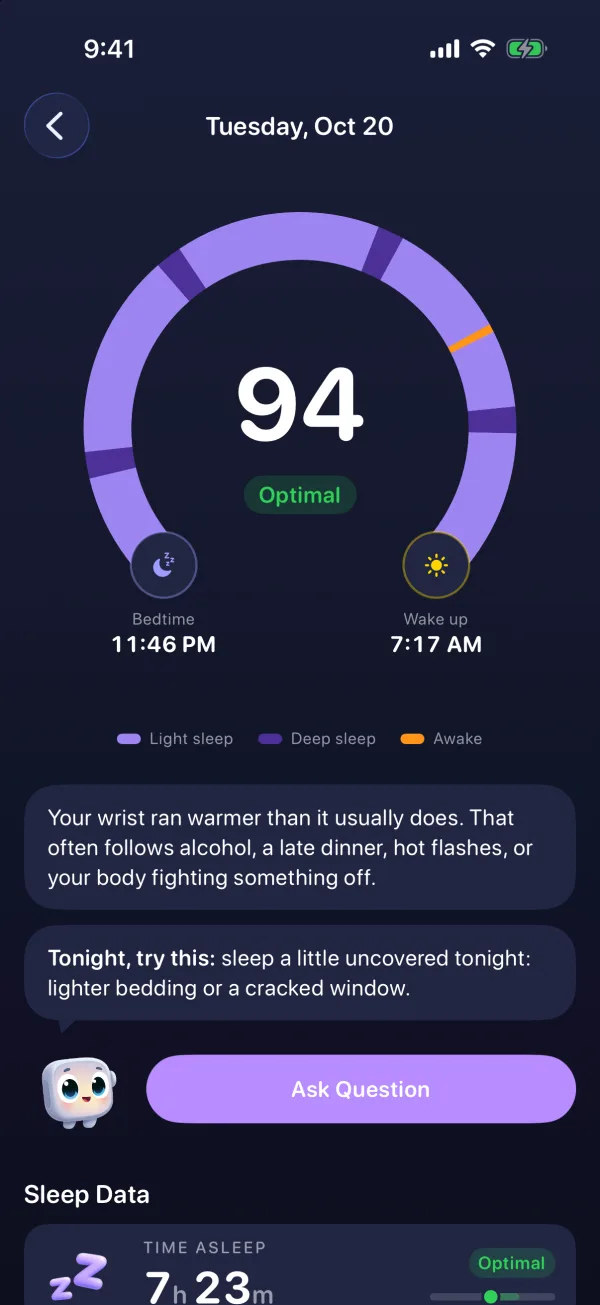
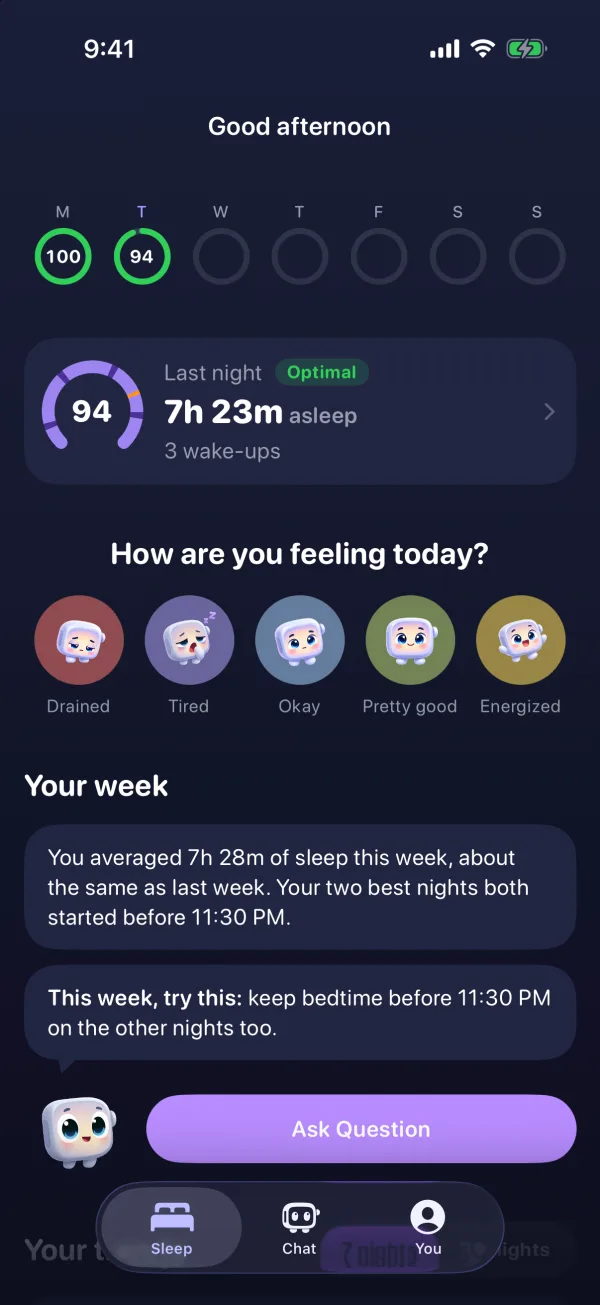
Each morning, Wristy, the app's friendly watch mascot, explains your night in plain words and suggests one simple thing to try tonight. You can also tag your evening (alcohol, late caffeine, screen time, medication) to see how it plays out at 3 AM. Sleepwrist is a wellness app, not a medical device, and it does not diagnose insomnia or sleep apnea, but it can give you clear notes to bring to your doctor.
Is there a spiritual meaning to waking up at 3 AM?
Many people search for the "meaning" of waking at 3 AM, and you will find ideas online linking that hour to spiritual messages, energy or specific organs. These beliefs can feel comforting, and if reflection or prayer at that hour brings you peace, that's yours to keep. There is, however, no scientific evidence behind them. The body-based reasons above (lighter sleep, hormones, temperature, alcohol, stress) explain the pattern well, and they have the advantage of pointing to things you can change.
When to see a doctor about waking up at night
Talk to your doctor or a sleep specialist if:
- you wake up several times a night and struggle to fall back asleep, most nights, for weeks;
- you feel exhausted during the day even though you spend enough time in bed;
- you snore loudly, or someone has noticed you gasp or stop breathing in your sleep;
- anxiety, low mood or pain is keeping you up;
- night sweats soak your sheets regularly (here is when night sweats need a check-up);
- you think a medicine or health condition might be involved.
Bring a short log (what time you woke up, what you felt, what you did the evening before). It makes the conversation faster and more useful.
Frequently asked questions
Is it normal to wake up at 3 AM every night?
Waking briefly during the night is normal, and many people do it at a similar time because of how sleep cycles and body rhythms work. It becomes worth looking into when you can't get back to sleep, when it happens most nights, or when you feel tired during the day.
Why do I wake up at 3 AM and can't go back to sleep?
By 3 AM your deep sleep is mostly done and your stress hormones are starting to rise, so once you are awake, a busy mind can keep you there. Avoid checking the time, cool down, breathe slowly, and if 20 minutes pass, get up and do something calm in dim light until you feel sleepy.
What does it mean when you wake up at 3 AM in menopause?
Often it means hormone changes are affecting your temperature control and your sleep depth. Hot flashes and night sweats are a common trigger, and trouble staying asleep is the most frequent sleep complaint during the menopausal transition. Your doctor can talk you through treatments if it is wearing you down.
Can anxiety make you wake up at 3 AM?
Yes. Stress and anxiety are among the most common causes of night waking, and the natural early-morning rise in cortisol can make it easier to wake up wired. A calming routine and CBT-I, a proven talking therapy for insomnia, help many people.
Does alcohol make you wake up at 3 AM?
It often does. Alcohol can help you drift off, but as your body processes it, sleep becomes lighter and more fragmented, with more awakenings in the second half of the night. Stopping at least three hours before bed helps.
Can an Apple Watch tell me why I wake up at night?
An Apple Watch records when you are awake and which sleep stage you are in, and some models also record wrist temperature. It doesn't tell you the cause on its own. An app like Sleepwrist can line up your wake-ups with your temperature, heart rate and evening habits to show the most likely pattern.
Sources
- Sleep Foundation, Why Do I Keep Waking Up at Night?
- Woolcock Institute of Medical Research, The 3am wake-up
- Cleveland Clinic, Why You're Waking Up at 3 a.m.
- Sleep Foundation, Alcohol and Sleep
- Sleep Foundation, Best Temperature for Sleep
- Baker et al. (2018), Sleep and Sleep Disorders in the Menopausal Transition, Sleep Medicine Clinics
- National Institute on Aging, Sleep Problems and Menopause: What Can I Do?
This article is for general information and does not replace advice from your doctor. If your sleep problems last more than a few weeks or come with other symptoms, talk to a healthcare professional.